
Lok Sabha Erupts as Rahul Gandhi and Kiren Rijiju Spar Over Economic Policy and Privatization
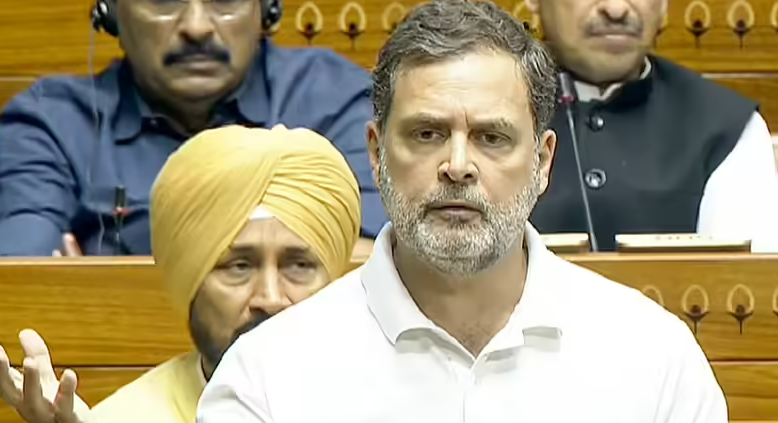
The Lok Sabha witnessed a high-decibel clash during the ongoing Budget session as Leader of the Opposition Rahul Gandhi and Union Minister Kiren Rijiju engaged in a fierce war of words over the government’s economic trajectory and its aggressive push toward privatization. The confrontation began when Rahul Gandhi launched a scathing attack on the treasury benches, alleging that the current administration’s fiscal policies are designed to benefit a select group of “crony capitalists” at the expense of the common citizen. He claimed that by handing over strategic national assets—including ports, airports, and energy sectors—to a handful of industrial houses, the government was effectively engaging in a “sell-out” of the nation’s future. Gandhi argued that the budget fails to address the structural issues of unemployment and rural distress, focusing instead on tax breaks and incentives for big corporations while the middle class and the poor struggle under the weight of inflation.+1
In a swift and sharp rebuttal, Union Minister for Parliamentary Affairs Kiren Rijiju rose to defend the government’s economic record, dismissing the allegations as “baseless rhetoric” intended to mislead the public. Rijiju accused the Opposition leader of lacking a basic understanding of modern economics and suggested that his comments were detrimental to India’s global investment image. He contended that the government’s disinvestment and privatization strategies are aimed at bringing efficiency and transparency to sectors that were previously marred by bureaucratic red tape and inefficiency under decades of Congress rule. Rijiju emphasized that the capital generated through these reforms is being redirected into massive infrastructure projects and social welfare schemes, asserting that the “nation is not being sold, but rather being strengthened” through bold and necessary reforms.
The debate took an even more personal turn when Rijiju suggested that Rahul Gandhi’s habit of criticizing Indian policies on international platforms had now translated into a disruptive strategy within the Parliament. He challenged the Opposition to provide empirical evidence of corruption, asserting that the Modi government’s “Direct Benefit Transfer” system had eliminated the leakage of funds that was prevalent in the past. As the exchange intensified, members from the treasury benches and the INDIA bloc shouted slogans, forcing the Speaker to intervene multiple times to maintain decorum. The Opposition maintained that the budget lacks a vision for the 90% of the population that does not belong to the elite class, while the government insisted that the budget serves as a blueprint for “Viksit Bharat” (Developed India).+1
This confrontation highlights the deep ideological chasm between the ruling BJP and the Opposition regarding India’s path to becoming a global economic powerhouse. While the government frames privatization as a tool for modernization and fiscal discipline, the Opposition views it as an erosion of national sovereignty and a threat to social justice. The day’s proceedings concluded without a consensus, but the fiery exchange set the tone for the remainder of the session, signaling that economic inequality and corporate influence will remain the primary battlegrounds in the lead-up to future electoral contests.