
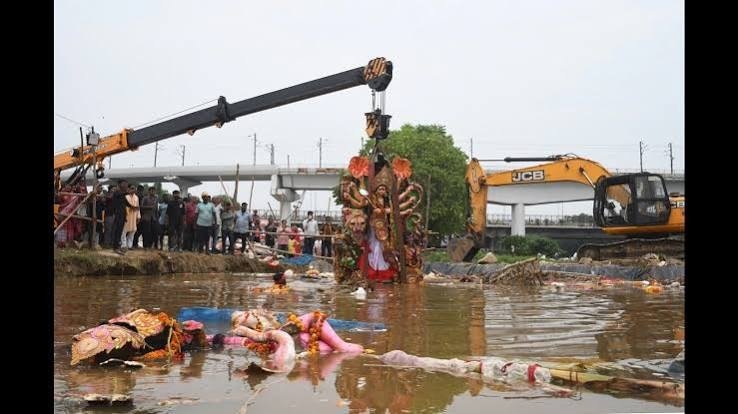
Brahmaputra Banks Littered with Plastic and Ritual Waste Post-Durga Idol Immersions
Following the conclusion of Durga Puja festivities on Vijaya Dashami, extensive piles of plastic waste, discarded floral garlands, and shattered bamboo structural frames have accumulated along the banks of the Brahmaputra River in Guwahati. As immersion processions extended over two consecutive days to manage the heavy influx of worshippers, around 600 community pujas were celebrated across the city this year, directing massive crowds toward seven key immersion sites, including Pandu, Lachit, Saukuchi, Basistha, Choonsali, Sonapur, and Panikhaiti ghats. At Pandu ghat alone, which expected over 250 idols, bright orange and yellow garlands, discarded synthetic containers, plastic bottles, polythene bags, and decorative materials were found entangled in water hyacinth and mixed with submerged wooden debris. While this visible floating garbage underscores immediate local waste management shortcomings, environmental experts emphasize that the full extent of ecological damage depends heavily on underlying chemical and microbial contamination. Official assessment from the Assam Pollution Control Board (APCB) is currently pending to evaluate critical water-quality indicators such as dissolved oxygen, heavy metals, and biochemical oxygen demand (BOD). Historical data collected by the Pollution Control Board of Assam (PCBA) during the 2023 immersion period recorded a noticeable deterioration in water metrics at Pandu ghat, where dissolved oxygen levels dropped from 8.4 mg/l down to 7.3 mg/l post-immersion, while BOD readings steadily climbed from 1.6 mg/l to 2.3 mg/l. Official environmental guidelines strictly prohibit the use of non-biodegradable thermocol, polythene, synthetic decorations, and toxic chemical paints on idols, yet non-compliant materials continue to pose long-term hazards to aquatic life. To handle the scale of operations safely, district authorities, the Guwahati Municipal Corporation, state health services, and the Pandu Ghat Immersion Committee coordinated logistics alongside deployed National Disaster Response Force (NDRF) and State Disaster Response Force (SDRF) personnel, who operated heavy hydra cranes and maintained round-the-clock water supervision. PCBA’s systematic water monitoring protocol spans three phases—before, during, and after immersions—focusing primary sampling at Pandu and Kacharighat to track real-time pollution surges. The environmental challenge continues to escalate as community celebrations expand rapidly across the state; Assam recorded 9,002 community Durga Puja pandals this year, reflecting a steady rise from 8,521 in 2025 and 8,381 in 2024. As increasing numbers of puja committees queue at prominent locations like Lachit Ghat and Pandu Ghat each season, environmentalists continue to advocate strongly for strict enforcement of traditional clay idols, natural organic dyes, and systematic post-event waste segregation to safeguard the Brahmaputra’s delicate river ecosystem.