
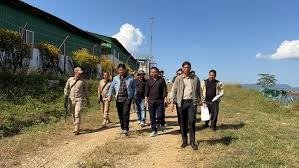
NTC Hails 46% Progress on Dimapur-Zubza Railway Project and Calls on Churches to Foster Naga Unity
The Nagaland Tribes Council has welcomed recent updates confirming steady progress on the strategic Dimapur-Zubza railway line to Kohima while urging executing agencies to strictly meet the December 2029 completion deadline without further delays. In a joint press statement, council president C. Pankathung Lotha and general secretary C. Onen Walling thanked the state government, particularly Chief Minister Dr. Neiphiu Rio, for responding twice to the council’s appeals for greater transparency regarding the vital infrastructure project. Following a comprehensive joint inspection by officials from the Northeast Frontier Railway and the state transport department, authorities disclosed that 45.98 percent of the 78.42-kilometer rail corridor has been completed with an expenditure of ₹7,176.48 crore incurred to date. The council noted that public awareness regarding construction milestones had previously been limited, making the official assurance of a December 2029 finish a highly encouraging development for commuters and businesses alike. Calling upon the Northeast Frontier Railway and its contracting partners to maintain momentum with full state government backing, the council emphasized that operationalizing the rail link will significantly reduce travel costs and streamline the movement of passengers and commercial goods between Dimapur and the state capital, Kohima. Alongside its focus on regional connectivity, the Nagaland Tribes Council commended the Fellowship of Naga Baptist Associations for successfully hosting a two-day Naga Prayer Summit at Lotha Baptist Church in Dimapur on November 10 and 11, praising its timely emphasis on community solidarity as essential to resolving the prolonged Indo-Naga political issue. Highlighting how decades of unresolved political negotiations have fueled internal divisions, public confusion, and burdensome taxation imposed by twenty to thirty different Naga political factions, the council underscored that churches and Christian institutions bear a crucial responsibility in championing peace, social harmony, and economic development. Specifically, the council appealed to leaders across all Christian denominations—including Baptist, Roman Catholic, Revivalist, Nagaland Christian Revival Church, and Pentecostal congregations—to step beyond the confines of church buildings and actively engage with the broader Naga society. Warning that persistent fragmentation risks triggering renewed turmoil and violence, the Nagaland Tribes Council urged religious organizations to unite in prayer and concerted outreach to bring all Naga political groups and the state government onto a common platform, thereby facilitating an honorable, inclusive, and lasting political settlement alongside sustained infrastructural advancement across Nagaland.